


 Posts


People often ask artists who has influenced their work -- musicians, painters, sculptors, filmmakers, writers. It's a tough question to escape. I've asked it, but not too often, because I've found that many good artists don't seem keen on bringing that kind of consciousness to their work.
I write intuitively, too. I try to edit consciously. And editing often seems to be slightly under the influence of whomever I'm reading at the time.
(Except Gabriel Garcia Marquez, Isabel Allende, and Joan Didion. They are always there.)
This year, Paige has left behind collections from University of Iowa students. Home of Iowa Writers Workshop, there comes from Iowa always something fresh, and often ever-so-slightly unworkable in those pages. I enjoy them. And my friend, RunnerSusan, has loaned me a dozen of her favorite works of fiction that have taken me down unexpected paths.
I took a break from reading the authors scheduled for this weekend's Mayborn conference to pour over essays for a writer's workshop. My essay, Carrion (see the pages on the left), has been accepted to the workshop, so I am reading the work of others who will be sequestered with me and our workshop leader. More new voices and ideas.
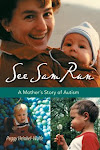
Like a book club, only on steroids, it's the eighth Mayborn writer's conference this weekend. It doesn't seem that long ago that I threw the manuscript for "See Sam Run" into the workshop to see what would happen. There won't be anything on that scale for me this weekend, but it will be for someone, and there is all that other talk of writing and reading and writing that is so inspiring to us all. I can't wait to see what this weekend will bring.
Showing posts with label language. Show all posts
Showing posts with label language. Show all posts
Monday, July 16, 2012

Friday, June 29, 2012
Writing Prompt #15
From Sam's summer school journal, proving metaphorical questions do not have to be answered metaphorically.
I would rather be a passenger on the plane because I look rather young to be the pilot. -- July 19, 2002
I would rather be a passenger on the plane because I look rather young to be the pilot. -- July 19, 2002
Monday, June 25, 2012
Writing Prompt #10 and #11
These entries from Sam's summer school journal seem about right for our first 100-degree day of the summer:
I would use sunscreen or sun tan lotion. If I didn't have any of that, I could wear a hat or stay in the shade. -- July 10, 2002
My favorite ways to cool down is to drink plenty of cold water or stay in my air-conditioned house. I could swim in a swimming pool. -- July 12, 2002
I would use sunscreen or sun tan lotion. If I didn't have any of that, I could wear a hat or stay in the shade. -- July 10, 2002
My favorite ways to cool down is to drink plenty of cold water or stay in my air-conditioned house. I could swim in a swimming pool. -- July 12, 2002
Sunday, June 24, 2012
Writing Prompt #9
I asked Sam if he could remember what the prompt was for this entry in his summer school journal. He couldn't. I've read this before and I still can't even come up with a guess what the kids were shown and asked to write about. Here it is:
I would have a sign that says "do not eat" or "I don't taste very good." I could even have it say "I am made of fake meat and bread." Probably would say, "Too late, I am rotten." It would even say "Frozen rock solid." -- July 8, 2002
I would have a sign that says "do not eat" or "I don't taste very good." I could even have it say "I am made of fake meat and bread." Probably would say, "Too late, I am rotten." It would even say "Frozen rock solid." -- July 8, 2002
Friday, June 22, 2012
Writing Prompt #7, or Explaining Frisbees on Mars
From Sam's summer school journal:
If I threw a frisbee into the air and it kept going up until I could no longer see it, it probably went into outer space and might've landed on Mars. -- June 26, 2002
If I threw a frisbee into the air and it kept going up until I could no longer see it, it probably went into outer space and might've landed on Mars. -- June 26, 2002
Monday, June 18, 2012
Writing Prompt #2, or why Texans love Blue Bell Ice Cream.
Sam opened his journal, which I'm now realizing must have been for summer school his freshman year, not high school English, given the date, by describing himself.
"My name is Samuel Donald Wolfe. I am 14 years old. So far my hobbies turn up to be games. I happen to like apples and bananas. My brother is 11 years old. My sister is 8 years old. My mother is 41 years old. She now works in Gainesville. My father is 45 years old He mows lawns, plays the tuba in concerts, and teaches in Arlington. I now have three dogs. I have two black dogs and one brown one."
Not sure why he has me working in Gainesville. I never did.
Below is the result of his second writing prompt:
My favorite ice cream is Vanilla, Peppermint, White Chocolate Almond, Orange and Strawberry Sherbet with Starburst pieces. There will probably be a new flavor ice cream. I would try to invent grape ice cream or blackberry ice cream. -- June 12, 2002
Sunday, May 6, 2012
Overheard in the Wolfe House #175
Sam: I don't know what grass it is that gives me allergies, but it survived the drought.
Peggy: Yes, it did.
Sam: It just waited for the rain and [claps hands together]. Like a logic bomb.
Peggy: Yes, it did.
Sam: It just waited for the rain and [claps hands together]. Like a logic bomb.
Tuesday, April 24, 2012
Talk to yourself and grow your brain
I have overheard my children talking to themselves over the years. This is a habit I don't have. Where I grew up, that was a sign someone had the crazies. But raising Sam taught me not to judge. He got the talk-to-yourself ball rolling for the younger generation around here. I asked Michael once recently, what did he think of all this talking to oneself. He was cool with it.
Apparently, so are the scientists.
Apparently, so are the scientists.
Wednesday, March 14, 2012
Waiting for the cable guy
Yesterday, I had the pleasure of calling Tom "Smitty" Smith for a story I was working on. He's with the Texas office of Public Citizen and I always learn something when I talk to him.
He wasn't in the office. He was at home, waiting for the cable guy. It had been a long wait, and we laughed about how it's always that way. I shared the little known fact that the actor (Daniel Whitney) created his Larry The Cable Guy by calling into radio shows.
Sam is a huge fan of Larry the Cable Guy, though not from his stand-up or his movies, but as Mater in Cars and Cars 2. During his sophomore year, he wanted to do his final paper for a film history class on Larry the Cable Guy. His humanities professor was reluctant, I could tell. He said his subject had to have made at least three movies. Lucky for Sam, Witless Protection was coming out. I showed him the IMDB web site, and he found some older movies, one of which was at the library, so he was in business.
Sam really went after that paper. He researched the actor's biography and the nature of comedy. His critical thinking grew in the course of researching and writing that paper.
I'd learned long ago that when Sam is motivated about a topic, he will learn as well or better than any other student doing the same work in a more traditional way.
His analysis of the actor and his work almost had me respecting the guy for his talents. And then I remembered all the fart jokes.
Thursday, February 16, 2012
Overheard in the Wolfe House #161
Sam (watching Wheel of Fortune): The Talented Cast of Glee!
Peggy: Wow, Sam. That's pretty good, since we never watch that show.
Sam: It just came into my head.
Peggy: That's because you can learn things from context.
Monday, January 16, 2012

Sunday, October 9, 2011
Things I Never Knew I Was Waiting For
I'm fond of telling my kids that their grandkids will be in awe of their childhood experiences -- all of what a computer couldn't do, how crude a smartphone was, how brutal medical practices seemed (that last idea comes courtesy of Star Trek IV The Voyage Home).
I tried to apply that perspective to all kinds of situations in raising Sam. Being aware that you are in pioneering territory is helpful. Lots of people have come before us to do the Lewis and Clark equivalent of defining the landscape of accommodating someone with a disability and laying the groundwork with the public policy that opened up this new frontier of living with a disability.
I try to remember this journey as the Wolfe family Conestoga wagon settling the autism frontier. Nearly every day something new, something without precedent. Sometimes it's exhilarating. Sometimes the risks are clear and present. And always, always, exhausting.
The pioneering days of speech therapy are behind us. If someone in the discipline was interested in a exit interview, I have things to say about what worked and what didn't. I would imagine Sam does, too.
Never was that more clear than when I read the following line in Diane Ackerman's book, One Hundred Names for Love (a book about her husband's stroke and continuing recovery from aphasia, which has some interesting similarities to Sam's speech impairment). She describes a scene where her husband, Paul West, also an imaginative writer, struggles with fill-in-the-blank worksheets meant to help him regain his ability to talk.
"Choosing the correct answer could be as tough as herding cats. But, like most people, I did know the accepted answer. Selecting it, I had to ignore all other answers that spring to mind or were truer to my experience."
Correct is not the same as accepted.
Furthermore, we cannot ascribe too much meaning when a client cannot come up with the accepted answer.
I tried to explain that in my book, when I relayed Sam's experience of confronting vocabulary cards with images of things he'd never seen before. Diane absolutely knocked it out of the park, explaining the inherent social context of many speech exercises.
I think it could be a much bigger problem than those working in speech therapy might realize.
Throughout the book she describes "deliciously ambiguious words" and takes us on verbal joy rides with them. She sprinkles phrases without context and then gives us a fun house worth of perspectives to show how much we depend on context for meaning.
I wish I knew that two decades ago. I can only imagine how much better his speech therapy would have been. I wish I knew that a month ago when we were hit again with this problem.
I wish I knew these things I never knew I was waiting for.
Wednesday, October 5, 2011
Love Letter to Steve Jobs
In 1990, Mark and I didn't know anything about autism. But our little boy couldn't talk and we feared the worst.
Sam was drawn to a simple, hypercard game, "Cosmic Osmo," that came already loaded on our first MacIntosh computer.
As he played, we saw that even though Sam couldn't speak, he could think.
We never got to thank you while you were here, Steve Jobs. Today, I'm sure Mark got that covered.
Sam was drawn to a simple, hypercard game, "Cosmic Osmo," that came already loaded on our first MacIntosh computer.
As he played, we saw that even though Sam couldn't speak, he could think.
We never got to thank you while you were here, Steve Jobs. Today, I'm sure Mark got that covered.
Friday, September 23, 2011
Auto Identity Theft
Sam got pulled over again in Flower Mound.
He tried to tell me this once before, that his car identity had been stolen. It made no sense to me. His car had caught that officer's eye because he was in the wrong lane for a moment, so I thought the license plate story was getting lost in translation.
Kind of like the aphasiac talk in Diane Ackerman's book, One Hundred Names for Love.
But today, he explained it well enough that I knew I had to make a call.
You see, the officer recommended that he just get new license plates. That kind of recommendation doesn't get lost in translation.
I made a follow-up call to the police department and the officer who pulled him over set me straight. Someone got a ticket in Balch Springs and didn't pay it. When they issued a warrant for her arrest the warrant went out on both her driver's license and her car license.
What got lost in translation was that girl's license plate being entered in to the database. Sam got his tags at the Denton County Tax Office in 2008.
Guess where we're going Monday? We aren't going to try to bother telling Balch Springs his are not the tags they're looking for. We're going to solve this expeditiously.
Well, as expeditiously as a human being can experience the tax office.
Monday, September 12, 2011
Lights in London
I promise not to subject you to a bunch of home movies -- especially as aged as these images have obviously gotten -- but I couldn't help myself with this one.
When the Dallas Symphony went on its first European tour in 1997, Mark was hired as second tuba. I went along for the first half of the trip as an orchestra groupie. We had a blast.
We left the kids -- Sam was 9, Michael was 6, and Paige was 4 -- in the capable care of my parents. But we took the camcorder to capture things we thought would interest them on our return.
The videos sat in a box for years after our VHS player died. I borrowed one from my parents this summer and, with the help of a Pinnacle Dazzle, have begun digitizing the handful of family videos we have.
We made this little ditty in London when we realized how much fun Sam would have had, if he had been there to play with the light switches.
This was the first time I've heard Mark's voice since the week he died. I'm not sure who was grinning bigger tonight when we captured this first "movie," Sam -- re-living a favorite childhood memory -- or me, remembering the sound of the love of my life.
Thursday, July 7, 2011
Texting
With the upgrade to iPhones, Sam and I can now text each other. I've watched Sam play with spelling and language on Facebook and knew that he could handle some communication shortcuts. I've watched him use some numbers in place of letters. I was curious what our first crash-and-burn would be like texting.
Our first crash and burn came from the auto-correct.
Me: "Maybe charge the tractor when you fervor from work and let's try to start it again tonight."
When I pressed send, I saw that "fervor" was in place of "get home".
(Awesome guess there, by the way, Mr. Auto-Correct Editor.)
Immediately, I followed that with: "Stupid auto correct. Get home, not fervor."
Within 30 seconds, my phone was ringing.
"Mom, I did not understand your text message AT ALL."
I didn't even try to explain or translate.
"Sam, please just charge the tractor. I'll explain what happened with the text when I get home."
Damn You, Auto Correct.
Wednesday, June 29, 2011
That All May Read
Yesterday we mailed back the digital playback machine from the Texas State Library. Sam has been a client of the Talking Books program since elementary school. Many nights the boys put in a Harry Potter book, or Hank the Cowdog, or Lemony Snicket, and fell asleep as the story unfolded.
That doesn't really work for Sam's life anymore. He's working two jobs and, come fall, will be taking two classes online -- just 12 more credit hours, four easy classes -- and he'll have his associate's degree.
I bought him a Kindle two Christmases ago, in hopes that the Kindle -- which has the capability of converting text to speech -- would fill the gap in his life.
It helps when a textbook is available as a Kindle edition. The book can be read to him and that improves his comprehension. We can't expect the Talking Books program to keep up with that kind of need.
But book publishers don't want to cooperate with the e-reader formats. They likely consider what happened to the music industry as a cautionary tale. His most favorite books aren't available, probably because the most popular authors know that where they go, is where the e-reader goes.
We'd pay for the damn books if they play nice with Kindle, which had the decency to offer text-to-speech. We'd buy another e-reader if they would quit buckling to the audio book market and enable text-to-speech.
While everyone else waits for market dominance -- or, in the case of JK Rowling and PotterMore, apparently positions for the continued chaos -- people like Sam can't participate.
It just shows how little we really think about people when our vision is clouded by money.
Wednesday, June 30, 2010
Overheard in the Wolfe House #6
Sam (turning off the electric razor): That's it. I give up.
Peggy: Trying to get every last hair? Smooth as a baby's bottom? [pause]. That's an analogy Sam.
Sam: No it isn't. That's a simile. [launches into a detailed explanation of the difference between the two, with examples.]
Peggy: Thanks, Sam.
Saturday, June 12, 2010
Question authority
I'm on the hook for two presentations at the Texas Parent-to-Parent conference in San Marcos June 24-26. In one presentation I'll be working with Shahla Rosales, a professor of applied behavior analysis at the University of North Texas, on ethics in treatment decisions. She's come up with six guideposts for clinicians. She shared them with me a year ago and they resonated so wonderfully for me, as a parent, that I proposed we offer the same talk for parents at P2P.
I'm so lucky that she said yes.
I'll be teeing up the talk, sharing some of those school-of-hard-knocks stories that seem to define the world of parents who have children with disabilities. I'll focus on some of the hazards in our attitudes and fallacies of thinking. Shahla encouraged me to key in on one common fallacy of reasoning that clinicians bring to the table with treatment decisions -- appealing to the wrong authority.
Treatment choices should be evidence-based, but not all evidence is created equal, Shahla reminded me. Parents are sometimes in a better position to vet the rigor of evidence simply by questioning its authority with clinicians. Simply put, ask them to explain it to you.
Case in point: when Sam first began receiving services in preschool (I shared this story in my book), I was lost during an ARD/IEP meeting that went over test results. The speech therapist said that Sam could not touch his nose when he was asked. I asked her why that was important. From my perspective, as a young mom, I knew Sam "couldn't do" things. That was why we were there in the first place. The teachers and therapists developed an exhaustive list of things Sam wasn't doing, which did me no good. I could have written the list out for them and saved them a lot of time. But I asked the therapist to explain why he wasn't doing some of those things, and was stunned when she couldn't answer me.
Of course, she was embarrassed.
She followed through, however. She called up a former professor and called me several days later with the answer.
She said that most young children learn words from context. If you point out the zit on your nose, talk about blowing your nose, get a tissue to wipe your nose, or bump your nose on the door, and make some drama over that, most children learn that "nose" belongs to that sticking-out thing on your face. I recognized that Sam needed to be told things directly to learn them. After that telephone conversation, I stuck a computer label identifying dozens of things in the house for Sam. I also made him a shoe box full of vocabulary cards.
That and other direct interventions helped his early vocabulary explode.
I try to remember to be brave and ask questions and have things explained to me, because it never fails in creating a better environment for learning.
The hippies got that one right: question authority.
Friday, May 7, 2010
Kindle for special readers
Sam is finishing his second all-online computer class this semester, Introduction to Database, a class for which he had two versions of the textbook -- traditional and Kindle.
He was slow to warm to the Kindle, Amazon's e-reader that I bought him for Christmas, but by the end of the semester, his study routine depended heavily on two key features -- "text-to-speech" and "search this book."
By the middle of the semester, he got in the habit of starting each tutorial with the Kindle reading the opening scenario and concepts to him. When he got to the working steps of the tutorial, he went back to the textbook, so he could slow the pace down.
We found that to be one of the disadvantages of the text-to-speech feature. You have to turn it off in order to navigate around the book.
[I can see why the Kindle was abandoned by some universities that were trying it out -- accessibility problems and some publishers holding onto reading rights (um, publishers, let's differentiate between that and performance rights, ok?)]
When Sam got to the end of a tutorial or unit, he used the search to hunt down passages to evaluate true/false or multiple choice questions on his quizzes. His quizzes were timed -- he had an hour to answer 20 questions -- so the Kindle had the potential to get him to the right spot quickly.
Occasionally a quirky search result made us wonder if a low battery affected the power of the search.
After several tutorials, the professor provided a long list of prompts that went back through three or four chapters in order to prepare for the exam. Sam has long been accustomed to using indices and glossaries, but I watched him use the Kindle to make quick work of those searches, too.
One note of caution: the reader who is spatially oriented won't like how the search-the-book feature drops you into the middle of a passage without any sense of where you are in the book. Locations are numbered. There is nothing in the margins of the screen that specify the chapter, page number or any other context, unless you happen to fall below a heading of some kind.
Along the way, I showed him how to use other features -- highlighting and annotating. Sometimes, a concept was better understood by highlighting the the topic sentence of several consecutive paragraphs.
And sometimes, I could explain a concept better than the author, so I inserted an annotation. Sam is smart, and most of the concepts are explained plainly and directly, but not always.
We writers that think we are being crystal clear with our explanations find out how sorry our directions are with readers like Sam.
For example, in the guidelines for designing a database, the first recommendation is "identify all the fields needed to produce the required information." Translation: make a list of the fields. Next, "organize each piece of data into its smallest useful part" and "group related fields into tables." Translation: break up any fields that can be made smaller, then sort them.
I really couldn't translate the concept of "putting common fields in each table." At that point we had to draw a lot of pictures and work with a lot of examples.
Which, by the way, the Kindle needs a drawing tool.
[Sam never liked writing in his books, since he always wanted to sell them back at the end of the semester. I've learned that computer majors and music majors experience obsolescence in their disciplines at a different pace.]
With charts, the Kindle also comes up short. The text-to-speech feature doesn't read them. And they enlarge only one level (you have to position the cursor over them until the plus-sign appears in order to enlarge them.) If Sam hadn't had the book, he wouldn't have been able to complete some of the later assignments, because the book asked him to copy code in the chart.
The embedded dictionary is a powerful feature. Early in the semester, Sam needed a lot of the early vocabulary defined for him. With previous courses, he often skimmed past unknown words hoping he'd get the context eventually. I could see the point -- everything is moving so fast if you spend too much time looking up words you're scared of getting even further behind.
I don't think professors realize how much new vocabulary they throw at their students at the beginning of the semester.
All in all, though, Sam said he'll be looking for Kindle versions of next year's textbooks. It was a powerful tool. He recognized it's power when I first showed it to him, and was almost afraid of it (he called the dictionary "addictive"), so if you plan on introducing it to your special reader, go slow at first. Look for teachable moments, they'll come.
I knew we were good when I borrowed it one morning and had to promise to have it back by that afternoon.
Subscribe to:
Posts (Atom)